Thousands and thousands of cattle grazed in the hills and forests of Strathspey during the 18th century they were even taken up into the sheilings and high Corries in the summer. They were looked after by herdsmen who stayed in shielings in the hills while their relatives stayed at home and gathered the crops for the winter feed. They were 'driven' along the old drove roads either to lower level farms to be fattened for market, or straight to the market - sometimes Smithfield in London! Later came great flocks of sheep which had a dramatic influence on the landscape and wildlife. In some ways the cattle were replicating the effects of the ancient cattle that were present when humans arrived. Generally speaking we say cattle are good for wildlife and sheep are bad. The low intensive farming that started centuries ago and was little changed until the mid 1960’s gave ideal habitats which were not associated with the original forest environment. The high ground and forest which had been grazed by sheep for over 100 years ended in 1960 when it was decided to take the sheep off the ground to regenerate the trees and look after the deer. Today cultivation is only carried out on the alluvial soils, mainly alongside the rivers.
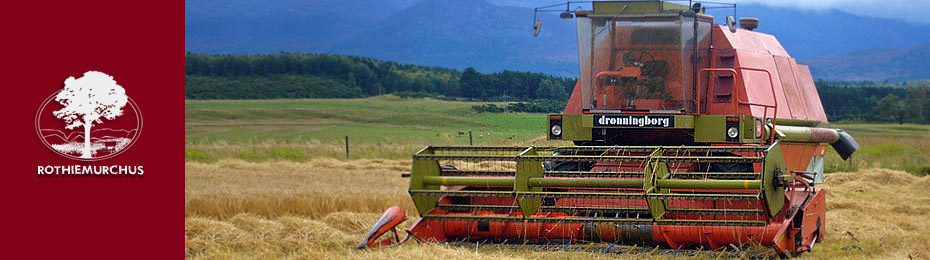
The home farm, managed by the estate, aims to produce about 200 tonne of barley for malting for the distilleries to make the malt whisky for which the area is world famous. In 2004 we were very surprised and delighted that our barley, grown at 800 ft. above sea level won the best overall malting barley sample for the North of Scotland.
We expect about 90 beef calves to be born of which 45 are Pedigree Highland sold as the highest quality beef from the Farm Shop or kept for breeding, 45 are Highland crossed to other breeds and their calves are sold to low ground farms when they are a year old. In the Highlands of Scotland cattle are traditionally known as land improvers; their wide mouths take in everything, not just the sweetest grasses that deer and sheep nibble at, so they enable the better more palatable and nutritious natural grasses to thrive; in the old native forest they can create bare patches on the forest floor for young seedlings to get a start from the natural seed that is plentiful in the forest. The best tree regeneration on Rothiemurchus is on land opposite the Coylum Bridge Hotel entrance which had been well grazed by cattle for nearly a 100 years.
In addition there are the two tenanted farms, Upper and Lower Tullochgrue and Achnahatnich. They produce young cattle mainly for others to 'finish' and occasionally you might see wintering sheep from other farms as they have excellent shelter and better grass than the West coast hills where the sheep usually spend the summer. We also keep some red deer in extensive ‘parks’; they breed naturally and live on grass and the young ones are used in the Farm Shop to supplement the wild supply at the times of year when it is illegal to shoot red deer; or when the hinds are calving or the wild stags are not good to eat. These deer will come right up to you when you are on a Land Rover or Coach tour with a Rothiemurchus Ranger.
From 1976 when the fish farm and fishery was established, Rothiemurchus produced rainbow trout; the farm is now operated by Scot Trout Ltd. We sell some fish at the Farm Shop but most go to their processing and packing room near Glasgow and are delivered to major retailers such as M & S, within 24 hours of leaving here. You can feed the fish which can be very exciting as there might be thousands of fish in the pond; they are amazing to watch close up. On much of the land you see will grow crops of grass or grass and clover. Growth starts after the long winter and the cattle graze it from the end of May until December. It grows very fast in the long daylight hours of May and June and much of it is cut in June and July to make grass silage and a little hay and this is what the cattle eat in the winter from Christmas until May. Sandy Mackenzie, his wife Liz and Johnnie Grant manage the farm assisted by other staff at peak times. A specialist contractor comes in to make the silage; about 600 tonne in one day! - enough to feed 100 cows for the winter. It is important that the grass is taken in dry and preferably sunny weather so that the grass pickles quickly. It’s the anaerobic (do not like oxygen) bacteria that produce the acid that preserves grass in a sweet state, so the cut grass is packed as tightly as possible into the pit and quickly covered in a plastic sheet to keep the air out. If done well, the result is high in natural protein and provides a complete natural diet for the cows that only has to be supplemented with some help yourself minerals and vitamins. |